Tired of your neighbor’s dog pooping in your yard and not picking it up? Whether it’s a one-time offense or a daily deposit, here’s how to report it legally, protect your property, and prevent it from happening again, without turning your block into a war zone.
You’re not overreacting. This is a real problem with real consequences:
- Dog poop can carry harmful bacteria like E. coli and parasites like Giardia
- It pollutes local waterways when washed into storm drains
- It damages lawns, kills grass, and smells worse with time
- It creates tension between neighbors, especially in tight-knit communities
- It leaves responsible pet owners frustrated when others don’t follow the rules
That’s where Poo Squad comes in. We take the crap, literally, off your hands. With background-checked technicians in bright orange uniforms, we don’t just clean yards, we protect peace of mind.
Stick with us, and we’ll walk you through exactly what to do, step-by-step.
Is It Illegal for a Dog to Poop in Someone Else’s Yard?
If you’re new to homeownership, you might be surprised to learn that yes, it’s absolutely illegal in most cities for a dog to poop on someone else’s property without cleanup. Whether it’s a public sidewalk, your front yard, or the strip of grass between the street and curb, it’s not a free-for-all toilet zone.
Here’s the legal lowdown:
- Most municipalities have pet waste ordinances requiring owners to pick up after their dogs immediately, even on someone else’s lawn
- HOAs can issue citations or fines for poop violations, especially if multiple neighbors have complained
- If the dog owner refuses to clean up after repeated offenses, you may have legal standing to file a nuisance complaint or code enforcement report
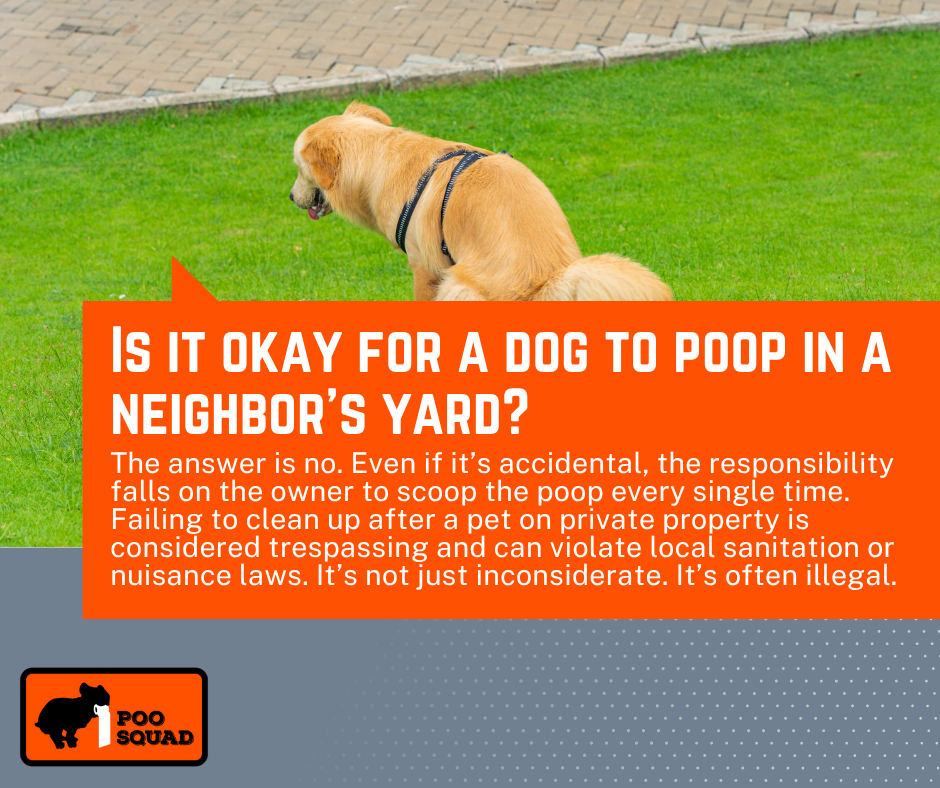
So if you’re asking, “Is it okay for a dog to poop in a neighbor’s yard?”, the answer is no. Even if it’s accidental, the responsibility falls on the owner to scoop the poop every single time.
Step 1: How to Talk to Your Neighbor (Without Starting a War)
Let’s be honest, talking to a neighbor about their dog’s poop habits isn’t anyone’s idea of a good time. But in most cases, a calm, respectful conversation is the best place to start. Especially if you’re retired or renting and want to keep things peaceful, the goal is to be firm without being confrontational.
Here’s how to make it go smoother than… well, the problem at hand:
- Stick to the facts: Explain that pet waste poses health risks, smells bad, and can damage your lawn, especially if it’s happening repeatedly.
- Assume they don’t know: They may genuinely be unaware their dog is doing it. Offer to walk the yard with them or show where it’s been happening.
- Offer a helpful solution: Suggest installing a shared pet waste bag dispenser or designating a better place for dogs to go (like a nearby grassy patch).
- Use “I” language: Say “I’ve noticed” instead of “You keep letting…”, it lowers defenses.
- If it continues: Send a polite but firm certified letter documenting the issue. It creates a legal paper trail and shows you’ve tried to resolve things amicably.
And if you’re worried about the interaction escalating? You’re not alone. Many people fear retaliation or awkwardness. That’s why documenting each incident can give you backup if things get messy, literally or legally.
Step 2: How to Collect Evidence (That Actually Works)
Before you go knocking on doors or calling the city, you’ll want proof, the kind that makes it crystal clear whose pup is the pooper.
Start by keeping a “poop log.” Yes, seriously. Note the dates, times, and where it keeps showing up. If the same pile shows up on Mondays after 9 a.m., you’ve got a pattern.
To gather stronger evidence:
- Set up a security camera aimed at the problem area (make sure it’s pointed at a public view or your property; privacy laws vary by state).
- Motion-activated sprinklers and ultrasonic dog deterrents won’t just collect info. They’ll often scare off repeat offenders.
- Snap photos or videos that include the dog and the person walking it. This confirms ownership and prevents denial.
Worried you can’t prove it was their dog? Don’t be. With time-stamped videos or photos, a well-kept poop log, and proof you tried to resolve it civilly, you’re building a solid case, just in case things go further.
Step 3: Report It the Right Way
If the polite approach and evidence collection don’t stop the poop parade. It’s time to report it. Thankfully, you have more options than you think, and yes, they actually work.
Start by contacting animal control, especially if the dog is off-leash or frequently roaming.
If you’re in an HOA or managed community, reach out to the property manager. They often have clear rules and quick solutions. Many cities also offer hotlines or mobile apps (like 311) that let you file complaints anonymously.
When you file your report, include your poop log, any photos or videos, and a summary of what you’ve already tried to resolve it directly. This shows authorities you’ve done your part.
Worried about fallout? Don’t be. Most municipalities allow anonymous reports, just ask, or use online forms that don’t require personal info.
Step 4: How to Stop the Problem Before It Starts Again
The best offense is a great defense. If you’ve cleaned up the mess and want to keep your yard poop-free, prevention is key.
Here’s what works:
- Use natural repellents like vinegar or citrus peels around high-traffic zones (skip the coyote urine, it can attract more dogs).
- Mulch, rocks, or rough landscaping make pooping less appealing than soft grass.
Install friendly but firm signs like “Please Curb Your Dog” or “No Poop Zone” to make expectations clear. - Ultrasonic deterrents or motion sprinklers are a non-confrontational way to discourage repeat visitors, especially if the dog walker is the real culprit.
As one responsible pet owner put it, “I’d be horrified if my dog did that without me knowing. But if someone had just told me, I’d have stopped it immediately.”
When It’s Time to Escalate
Sometimes, no matter how many conversations you’ve had, logs you’ve kept, or signs you’ve posted, the poop keeps coming. If you’ve tried being the reasonable neighbor and nothing’s changed, it might be time to escalate, but smartly.
Here’s what that can look like:
- Contact your city council or local environmental agency if the issue persists. Repeated dog waste left in residential yards can become a public health concern, especially when near storm drains.
- File a nuisance claim or take the matter to small claims court. These steps may sound extreme, but if your property is being repeatedly soiled and you’ve documented the pattern, you could be entitled to damages or an injunction.
- Use a mediation program. Many cities offer free or low-cost mediation services designed to resolve neighborhood disputes without a court. A neutral third party can often get through where neighborly chats have failed.
Why Poo Squad Is the #1 Trusted Destination
When you hire Poo Squad, you’re getting more than a poop scooper. It’s peace of mind. Here’s what sets us apart:
✅ Choose between weekly, bi‑weekly, or one-time cleanups so your schedule and yard stay consistent
✅ We never use your trash or hose, respecting your property and boundaries
✅ All our scoopers wear bright orange uniforms, carry ID, and are background-checked, so you always know who’s on your property
✅ After every visit, we send gate-closure photo proof so you know we did the job, and your yard is secure
On top of all that, we are licensed and insured, and we sanitize equipment thoroughly between jobs to reduce disease transmission (parvovirus, anyone?).
You deserve a service that’s safe, clean, and reliable.
FAQ
Can I complain about dog poo in my neighbor’s garden?
Absolutely. If their dog is using your yard as a bathroom, it’s your right to speak up and seek a resolution, even if it means getting authorities involved.
Will anyone actually take this seriously?
The answer is yes, especially when you have documentation. The more organized your complaint, the faster it gets escalated.
What happens if someone slips on it?
In some jurisdictions, failure to address known hazards like pet waste could impact homeowners’ insurance liability, especially if it results in injury to a guest, service provider, or delivery driver.

Author: Chief Scooper
Jamie Coones is the Founder and Chief Scooper of Poo Squad, a national dog waste removal company operating in over 20 locations across the United States. Since launching the company in 2017, he has helped redefine the pooper scooper industry through systemized operations, subscription-based service models, and a mission-driven approach to business ownership.